
Every language has its specialty, and that one special feature of a language influences every aspect of its functionality. When it comes to Rust, it has introduced something called the ownership model, which resolves memory-related issues in a unique way.
In JVM-based languages or similar ones like .NET or Python, garbage collection (GC) is used to free up memory. This approach works well in most cases; however, there are times when it compromises the efficiency or speed of the program.
With garbage collection, many memory management tasks are handled automatically, allowing developers to focus on other aspects of programming. In contrast, earlier languages like C and C++ require manual memory management, which introduces its own set of challenges. Rust attempts to address both these issues by introducing a new memory optimization technique: the ownership model.
This model makes Rust highly efficient and gives developers more control over memory management. Unlike garbage-collected languages, which require a virtual machine or an interpreter to manage memory, Rust runs directly at the system level. In those other languages, memory management relies on the garbage collector to clean up resources at the right time.
With the ownership model, memory is freed automatically when it goes out of scope, eliminating the need for a garbage collector. However, this requires a different programming approach. The ownership model has given Rust a complete makeover, making programming in it quite different from traditional languages.
Now, let’s dive into what the ownership model looks like. We’ll explore some examples to better understand its concepts.

Here is a simple example of how the ownership model works. We have declared a variable called x of type String in Rust style. Then, we created another variable called y and assigned x to it. When we do this, the ownership transfers to y, and x is no longer valid, so it will be removed from memory. Simple, isn’t it? Or is it really?
Although, it looks simple, we cannot avoid certain scenarios like ownership sharing, multi threading access or dangling pointers. In fact it changes the below features that other languages do differently or may be more
Variable handling
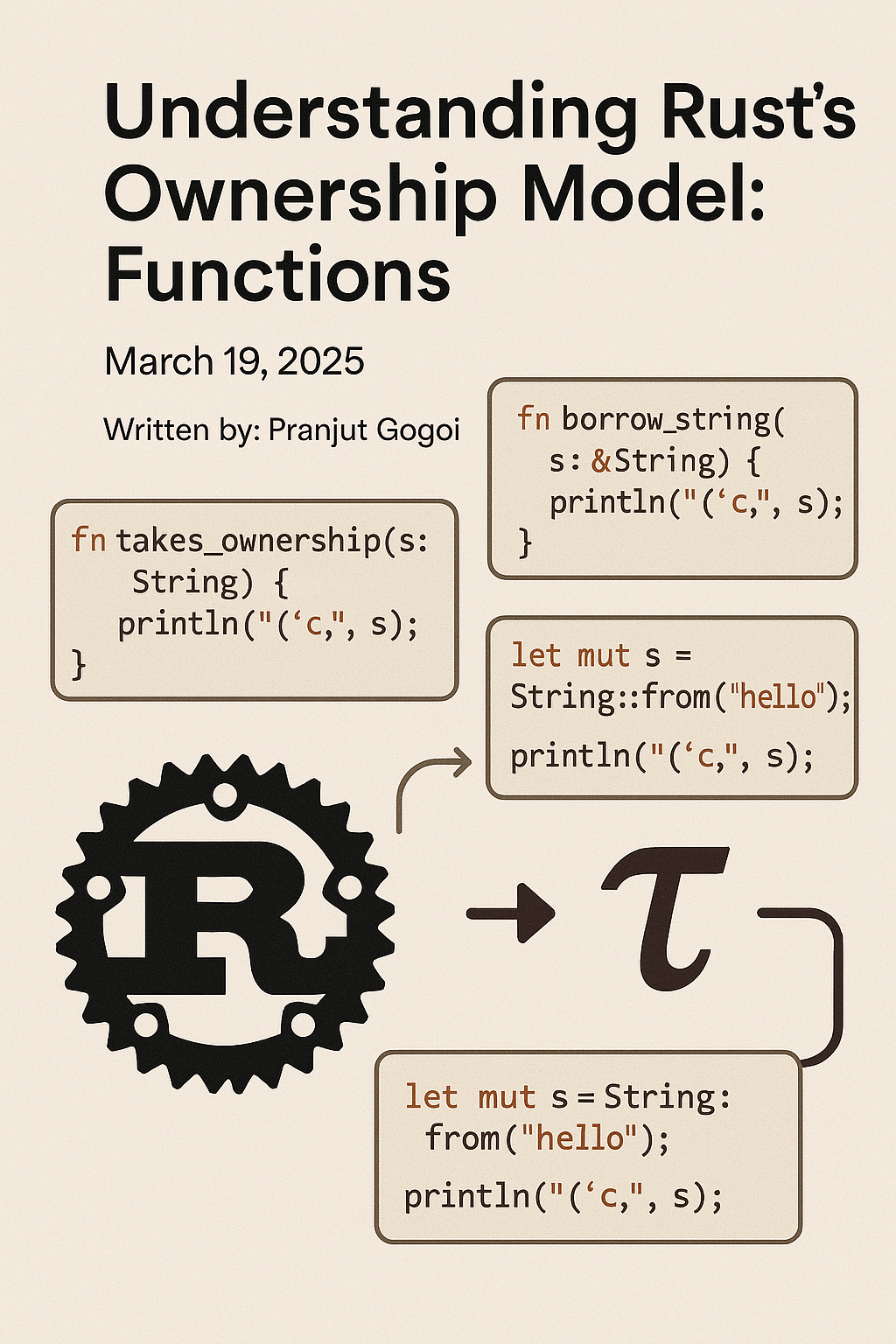
Function calls
Loops & iterators
Structs & objects
Collections & data structures
Concurrency & threading
Error handling
Smart pointers
Lifetimes & borrowing
I want to keep this blog bite size. Explaining everything here wouldn’t be possible, so check out the upcoming blogs where I break things down one by one.

 The Endless Odyssey