
If you’re a software developer or already working with a programming language, picking up a new one isn’t a big deal. Many concepts, syntaxes, and features overlap between languages, making the transition easier.
I’m a Scala developer, and before that, I worked with Java. Now, I’m looking to learn and adopt Rust. Instead of reading an entire book on Rust cover to cover, I prefer to first identify the commonalities between Scala and Rust—or Java and Rust—and then focus on their differences. After all, if you’re interested in a new language, it’s likely because it offers some technical advantages over what you’re currently using.
When learning a new language, there are three key areas to focus on:
- Commonalities – Identifying what’s similar between the languages allows you to move quickly through familiar concepts. Since you already understand them, they work the same way.
- Differences – This is crucial because certain differences can significantly impact how you write code. For example, if the languages follow different paradigms, your thought process in designing programs will change. In Scala, we emphasize functional programming and immutability, whereas Java follows an imperative style. These distinctions shape how we approach problem-solving in each language.
- Unique Features – Every language has features that make it powerful or compelling. These are the aspects that drive interest in adopting the language and should be given the most attention.
Through this blog, I want to start by covering the first part—identifying what Scala, Java, and Rust have in common. This way, we can quickly grasp the familiar concepts and then spend more time diving into the new ideas and features that make Rust an interesting and powerful language.
So, let’s get started.
Any language you choose will have the following features, though the syntax of each may vary.
- Variables and Data Storage
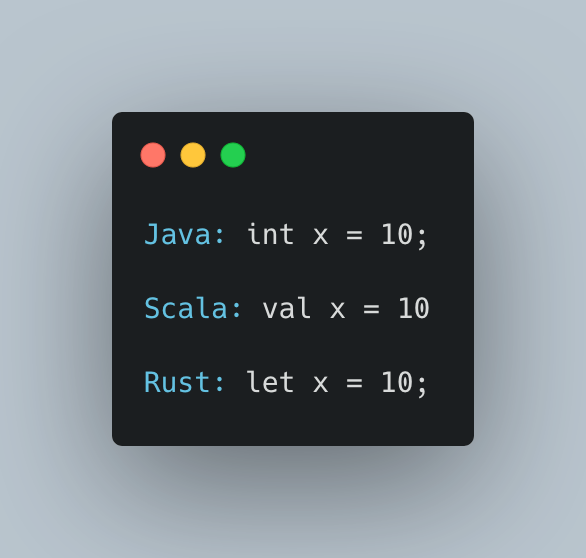
As you can see, we store the data in a variable in each language and use them to create programs. However the underlying concept of each language is different, specially regarding mutability and immutability. Which we will explore later when we will explore the differences and unique features.
- Data Types

Same goes with Data types as well. However we can observe that with data types the differences are more with syntaxes only, underlying concepts are more or less same among all the languages.
- Operators
When it comes to the operators all the operators seem to be same among all of them
arithmetic (+, –, *, /), comparison (==, !=, >, <), and logical (&&, ||, !) operators
- Control Flow (Loops, Conditionals)
In this section, let’s talk about conditional statements. Every language has if-else conditions, but Java does not return a value from them and instead provides a separate ternary operator (? :). In contrast, Scala and Rust only have if and else, and both return values from the if-else expression.
Regarding loops, all three languages share a common while loop. However, when it comes to for loops, Java handles them differently, while Scala and Rust have similar behavior but with syntactical differences.

And then each language might have some other loops according to their philosophy, making programmers life easy.
- Functions & Procedures
Functions allow reusability and modularity in all the languages with syntactical differences

- Object-Oriented Features (Most Languages)
Although Java and Scala share many object-oriented features, Rust takes a different approach. Unlike Java and Scala, Rust does not support inheritance, one of the four pillars of OOP. Additionally, it implements the other three pillars in a way that aligns with Rust’s philosophy. Since this topic requires careful attention to detail, we’ll cover it in a separate blog post.
- Error Handling
Whether it’s Java, Scala, or Rust, all of them handle errors, but in quite different ways. From my observation, Rust has learned from both Java and Scala, keeping the good aspects and removing the problematic parts. For recoverable errors, Rust uses explicit return types like Result<T, E> and Option<T>, which are similar to Scala’s Either and Option. For non-recoverable errors, there’s no need for manual handling, as Rust uses panic! to automatically free up resources.
- Memory Management
Memory management is available in all the languages we’re discussing. While Scala and Java rely on the JVM’s garbage collection to manage memory, Rust uses a different strategy called the ownership model. This is a larger and more interesting concept that deserves a detailed exploration. Let’s discuss it in another blog post.
- Standard Libraries
While Rust, Scala, and Java all provide standard libraries with built-in support for common tasks like math operations, string handling, file handling, and networking, there are key differences in how each language structures and provides access to these libraries. Let’s explore this in more detail in a separate blog, as we’ll likely be using these libraries frequently.
- Concurrency (Threads & Async)
Concurrency is present in all the languages we’ve discussed so far. However, over the years, it has become a key factor in choosing a programming language among developers. Rust introduces some truly innovative and proven ideas that present concurrency as a better approach compared to the others. We may need multiple blogs to explore this topic.
- Package Structure & Modularization
All languages allow breaking programs into modules or packages.e.g

In this blog, we’ve covered the similarities between Scala, Java, and Rust, which will help you quickly grasp common concepts when learning Rust. With a focus on what’s shared across these languages, we can dive deeper into the unique features that set Rust apart, like its memory management, error handling, and concurrency models.
Rust’s design offers compelling advantages, particularly its ownership model and advanced concurrency tools, making it an exciting language for modern software development. As we continue to explore Rust in future blogs, we’ll take a closer look at these distinctive features and why Rust is quickly becoming a favorite among developers.
Stay tuned as we dive deeper into Rust’s core concepts and why it’s such a powerful language for performance, safety, and scalability.

 The Endless Odyssey